
▼ In This Article
Event Management CRM: One System for Every Member, Renter, and Client
Every venue has people to keep track of: congregation members, season subscribers, recurring renters, league organizers, volunteers, and donors. When that information lives across spreadsheets, sticky notes, and inbox threads, relationships start slipping through the cracks.
A dedicated event management CRM built into your venue management system solves this by giving your team one shared, always-current view of every person and organization connected to your venue and how to serve them better.
Why Spreadsheets Stop Working
Most organizations do not set out to manage client relationships in spreadsheets. It usually happens gradually: a contact list here, a booking log there, and a folder of signed agreements somewhere else.
The cracks show up as you grow:
- No one has a full picture of a renter’s or member’s booking history.
- Follow-ups get missed because they lived in one person’s inbox.
- New staff have no context on long-standing relationships.
- Reporting on engagement or usage means manually piecing together multiple files.
An event management CRM fixes this by connecting every interaction, including bookings, communications, contracts, and notes, to a single profile.
What an Event Management CRM Should Actually Do
Centralized Contact and Organization Profiles
Every member, renter, client, or partner organization gets one profile with contact details, communication preferences, and a full history of past interactions.
Booking and Communication History at a Glance
Staff can see every past booking, every contract, and every conversation tied to a contact so any team member can continue the relationship without starting from scratch.
Segmentation for Targeted Outreach
Not every contact needs the same message. Segment recurring renters, one-time bookers, volunteers, and donors so reminders, renewals, and outreach go to the right people at the right time.
Notes and Preferences That Carry Over
Seating preferences, accessibility needs, feedback, and special requirements are captured once and available to whoever handles that relationship next.
Built-In Security and Privacy
Member, donor, and client information is sensitive. A venue CRM should protect it with role-based access controls, encryption, and clear permission settings.
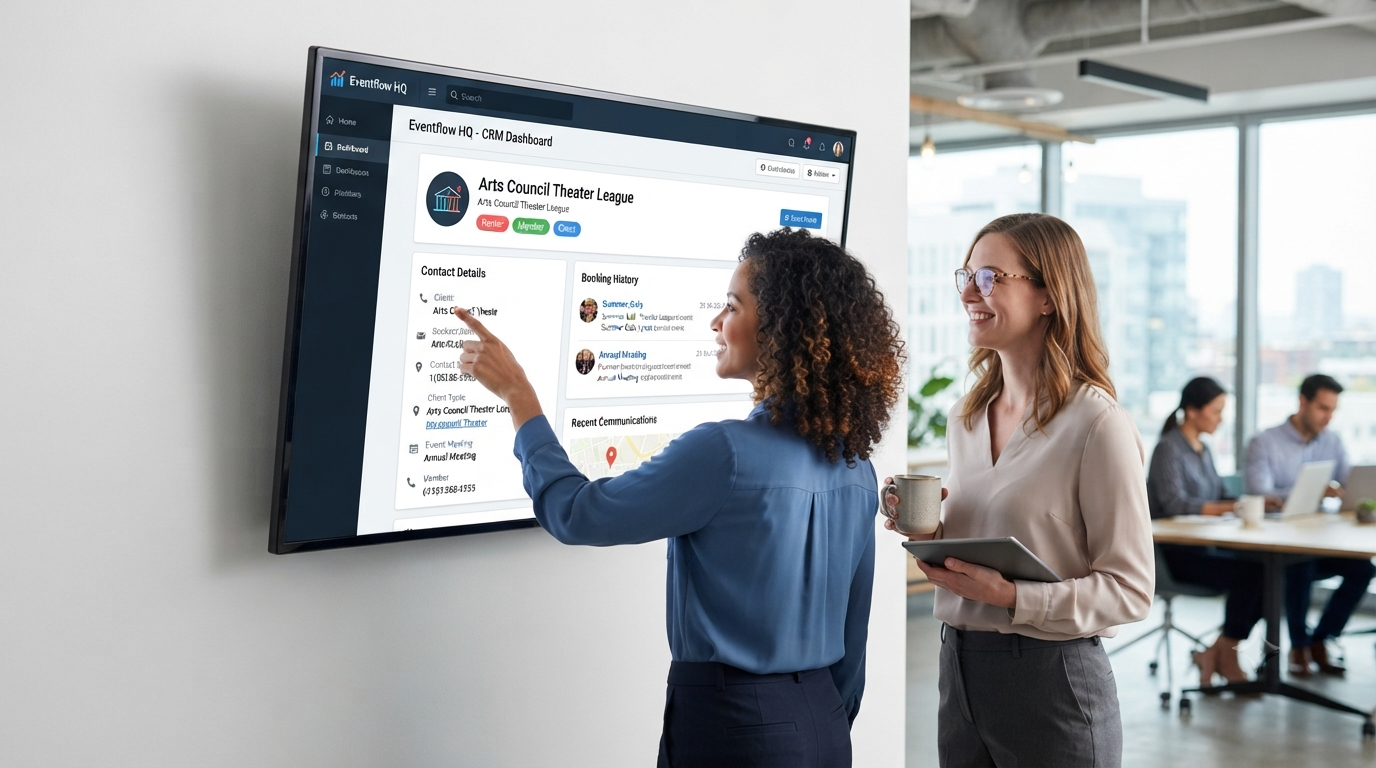
What This Looks Like in Practice
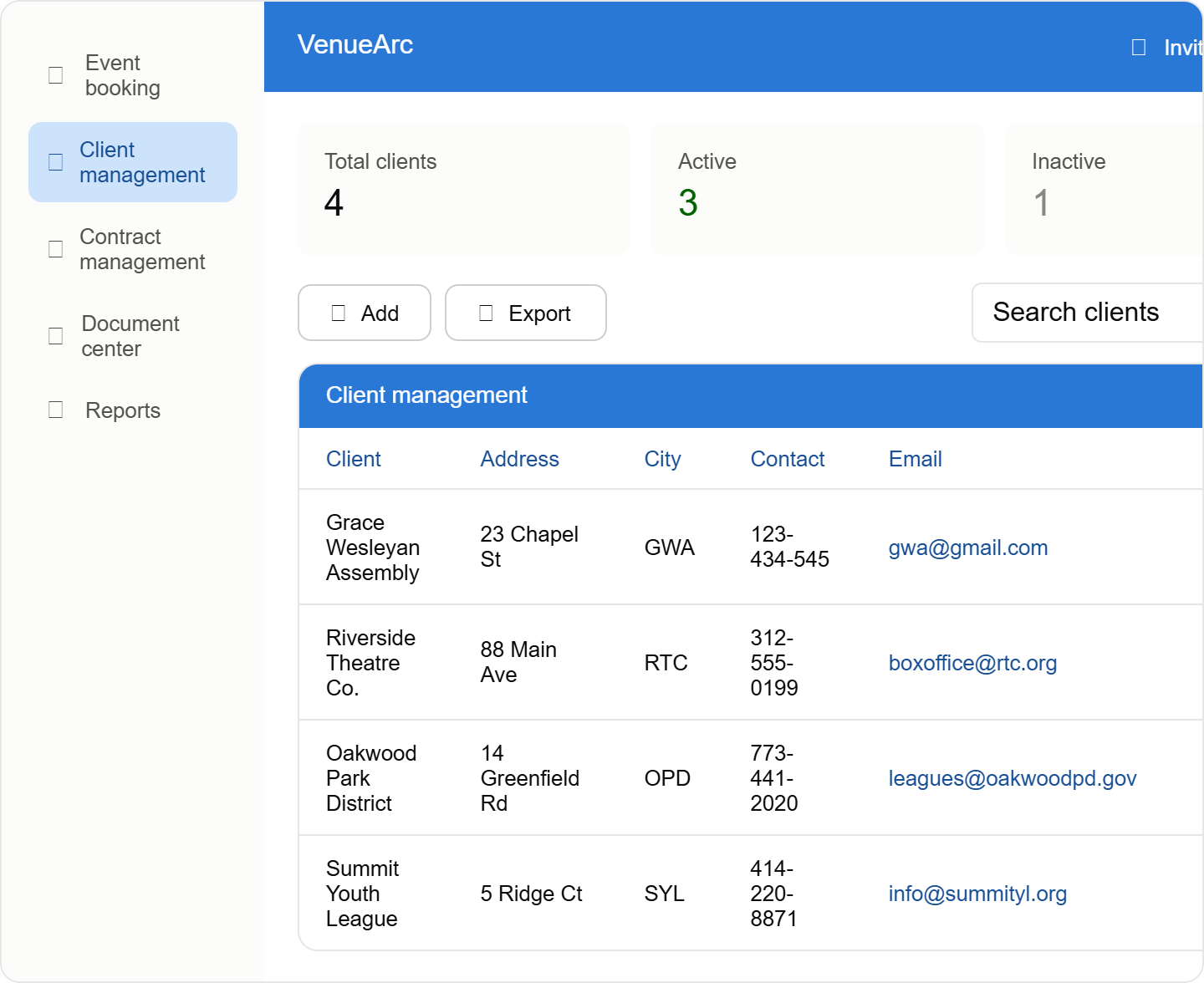
Houses of worship use member management software inside their event management CRM to track congregation members alongside outside groups renting space for community events.
Community theatres use patron management software to track season subscribers, single-ticket patrons, donors, and rental clients in one place.
Park districts use the same CRM to manage league organizers, instructors, vendors, and community group leaders across shared facilities with a clear record of who booked what and how often.
The Bigger Picture: CRM Is Part of a Connected System
A CRM works best when it is not siloed. Connected to your booking calendar, it shows relationship history alongside upcoming reservations. Connected to contracts, it surfaces signed agreements without separate searching. Connected to reporting, it turns relationship data into usage and engagement insight leadership can act on.
That is the difference between a standalone contact list and a true venue management CRM, where every interaction adds context instead of creating another disconnected record.
Ready to see it in action? Explore CRM capabilities, review booking workflows, or request a demo.
Frequently asked questions
- What is an event management CRM used for?
An event management CRM centralizes contact information, booking history, and communication for everyone connected to a venue — members, renters, clients, volunteers, and donors — so staff share one view instead of scattered spreadsheets.
The value is less about storing contacts than about connecting them to history. Knowing that an organisation has hired your hall every spring for six years, always asks for the same setup, and once had a billing dispute is what makes the next conversation competent rather than generic.
That history is normally the first thing lost during staff turnover. It lives in one person's inbox and memory, and when they leave, the venue starts over with relationships it has spent years building — which is a far more expensive loss than the administrative time saved.
- Do houses of worship need member management software?
Yes. Houses of worship use member management software to track congregation members and outside groups renting space, keeping schedules, communication, and agreements connected to the right contact.
The dual audience is what makes the requirement unusual. A congregation member and a commercial renter are entirely different relationships — one pastoral and long-term, the other contractual — yet both interact with the same building and often the same staff.
Keeping them in separate systems creates predictable gaps: a member organising a family event is treated as a stranger by the booking process, or a regular renter's agreement history sits somewhere nobody thinks to check. Connecting the record to the booking means whoever picks up the enquiry has the context, regardless of which relationship it came through.
- What is patron management software used for in a theatre?
Patron management software helps community theatres track season subscribers, single-ticket buyers, and donors in one place, so box office and development staff share the same relationship history instead of duplicate contact lists.
The duplication problem is acute in theatres because the same person appears in several roles. Someone can be a subscriber, a donor, a volunteer, and an occasional renter — recorded four times, in four places, by four different people.
The visible cost is embarrassing rather than merely untidy: a long-standing donor receives a first-time-buyer appeal, or a volunteer is asked to pay for a ticket they were promised. In a community organisation where relationships are the actual asset, those small errors do real damage to goodwill that took years to build.
- How is an event management CRM different from a general CRM like Salesforce?
An event management CRM is built around bookings, contracts, and event history from the start, so relationship data is automatically connected to scheduling and reporting — rather than requiring custom setup to bolt those pieces together.
General-purpose CRMs are extremely capable and can be configured to do this. The question is what that configuration costs. Modelling spaces, holds, conflicts, contracts, and settlement inside a platform designed around sales pipelines is a development project, not a setup task.
It also creates a maintenance obligation most venues underestimate. Custom configuration has to be documented, updated, and understood by whoever comes next — and when the person who built it leaves, venues frequently find themselves with a system nobody can safely change.
Want technology done right?
Get a free assessment from an Inc. 5000 Microsoft Solutions Partner.
Get Free Assessment ->