
▼ In This Article
VenueArc vs Momentus: Best Momentus Alternative for Venue Booking, Event Operations, and Settlements
If you’re evaluating a Momentus alternative, chances are you already know what Momentus does — you’re trying to figure out whether it’s still the right fit, or whether your venue would be better served by something built for how you actually operate day to day.
That’s a common position. Momentus (formerly Ungerboeck) is a well-known name in venue and event operations, particularly for large, complex venues like convention centers and stadiums. But plenty of venue teams — performing arts centers, community theatres, houses of worship, multi-site operators — find themselves paying for enterprise-level complexity they don’t need, or hitting friction around onboarding, learning curve, and pricing clarity.
This guide walks through what Momentus does well, where a lighter platform like VenueArc may be a better fit, how other alternatives compare, and how to evaluate any Momentus alternative without getting stuck in a feature-by-feature standoff.
A quick note before we start: software pricing, features, and product tiers change frequently. Treat the comparisons below as a starting framework, and confirm current details directly with each vendor before making a final decision.
VenueArc vs Momentus at a Glance
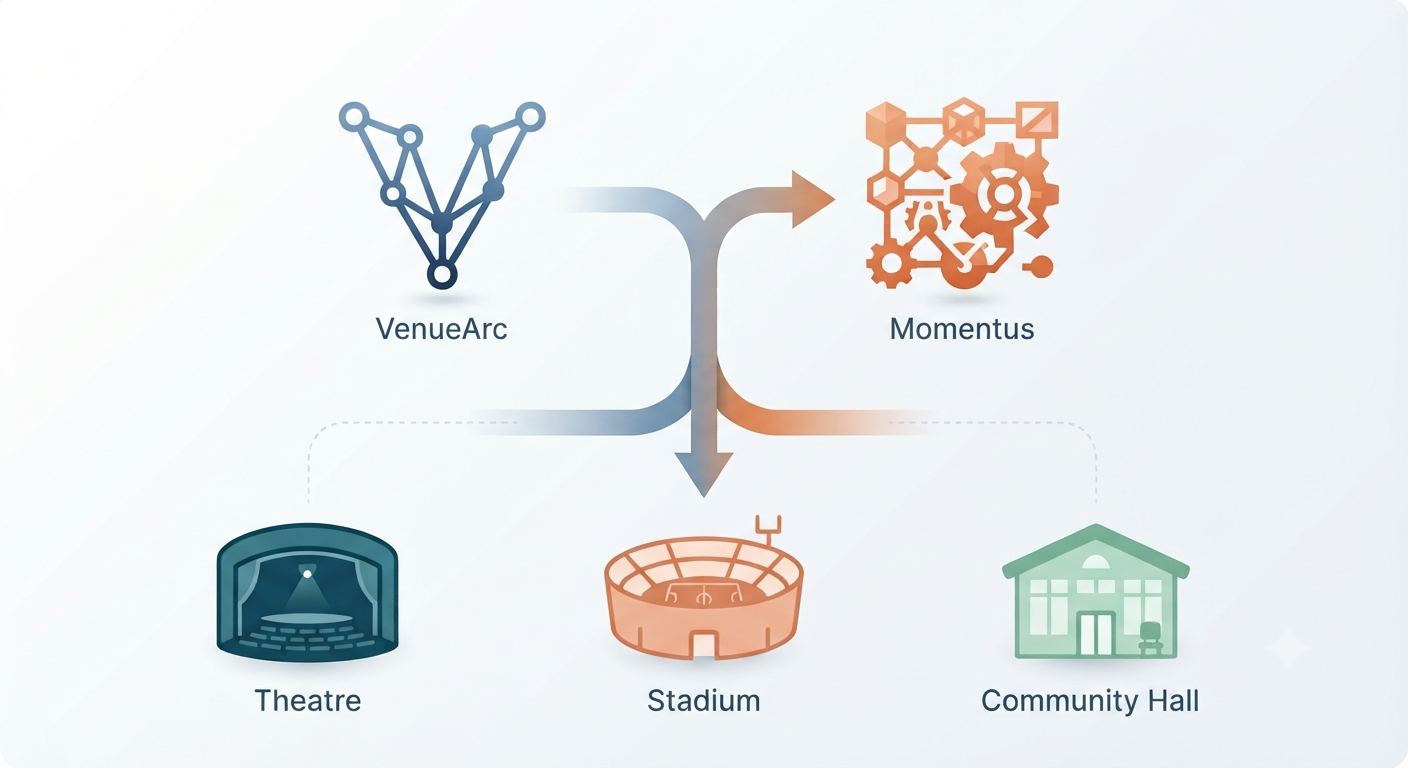
Choose Momentus if: you manage a large, complex venue — a convention center, stadium, or arena — with enterprise-level operational needs, a dedicated implementation team, and budget for a comprehensive, quote-based platform.
Choose VenueArc if: you want a practical booking-to-settlement workflow — booking, contracts, CRM, event settlement, and reporting — without the implementation weight and cost of a full enterprise venue suite.
Consider other alternatives if: your primary need is event registration, attendee check-in, or ticketing rather than venue operations — that’s a different job-to-be-done, and platforms built for registration (rather than venue booking) will likely serve you better.
Quick Recommendation by Venue Type
| Venue Type | Typical Fit |
|---|---|
| Convention centers / stadiums / arenas | Momentus (enterprise scale, complex multi-space operations) |
| Performing arts centers | VenueArc (booking-to-settlement workflow without enterprise overhead) |
| Community theatres | VenueArc |
| Houses of worship / multi-site churches | VenueArc |
| Multi-location venue operators (mid-size) | VenueArc |
| Hospitality-focused venues (hotels, restaurants) | Worth also evaluating hospitality-specific tools like Tripleseat or Event Temple |
| Attendee registration / ticketing needs | A registration-focused platform (Cvent, Accelevents, Eventbrite), not a venue operations tool |
![Quick recommendation by venue type for theatre, stadium, and community hall workflows]
What Is Momentus?
Momentus Technologies (formerly known as Ungerboeck) is an established venue and event management platform, particularly associated with large and complex venues. Momentus positions its platform around connecting booking, event operations, and financial management for organizations running high-volume, multi-space, or enterprise-scale operations.
Momentus offers multiple product tiers, including Momentus Enterprise and Momentus Elite, aimed at different scales of operation. Pricing is quote-based rather than published as flat tiers — Momentus’s own pricing page explains that cost depends on factors like scope, usage, number of events, onboarding needs, and optional add-ons, rather than a simple per-user rate.
What Is VenueArc?
VenueArc is a venue management platform built around a straightforward booking-to-settlement workflow: managing inquiries, availability, holds, contracts, event operations, settlement, and reporting in one connected system. It’s hosted on Microsoft Azure, with role-based permissions, Azure Active Directory single sign-on support, and integration options including Ticketmaster/Nexus for ticketing-adjacent workflows.
VenueArc is generally a better starting point for venues that want centralized operations and reporting without the implementation scope of a full enterprise suite — performing arts centers, community theatres, houses of worship, park districts, and mid-size multi-location operators are common fits.
What Momentus Does Well
To be fair to Momentus, it earns its reputation in specific scenarios:
- Enterprise-scale venue operations — built to handle the complexity of large convention centers, stadiums, and multi-space arenas
- Deep financial and operational integration — connecting booking, event operations, and financial management in one system
- Established market presence — a long operating history in the venue and event management space, with broad name recognition
- Comprehensive feature depth — for organizations that need it, Momentus offers extensive functionality across the full event lifecycle
Where Momentus tends to draw criticism, based on patterns across review platforms, centers on a learning curve for new users, onboarding complexity, and pricing that isn’t transparent upfront — buyers typically need a sales conversation to understand real costs. None of this makes Momentus a bad platform; it reflects the tradeoffs that come with a comprehensive, enterprise-oriented system.
What VenueArc Does Differently
VenueArc’s approach is built around a more direct question: can your team get from inquiry to signed contract to settled event, with clean reporting, without a lengthy implementation runway?
- Streamlined booking-to-settlement workflow — inquiry, availability, holds, contracts, event operations, settlement, and reporting in a connected sequence
- Azure-backed infrastructure — hosting, Azure AD SSO, and Azure SQL Database underpinning, which matters for venues already standardized on Microsoft tools
- Role-based permissions — access control tailored to different staff roles without enterprise-level configuration overhead
- A scope matched to mid-size and community-focused venues — rather than a platform built primarily for the largest, most complex operations
Side-by-Side Comparison
| Dimension | VenueArc | Momentus |
|---|---|---|
| Best-fit venue size | Small to mid-size, community and performing arts venues | Large, complex, enterprise-scale venues |
| Booking & calendar | Availability, holds, conflict prevention, recurring bookings | Full booking and multi-space scheduling for high-volume operations |
| CRM & sales | Client/contact management tied to bookings | Deeper sales pipeline tooling for enterprise sales teams |
| Contracts & documents | Contract generation tied to booking data | Contract and document workflows built for complex, high-volume event operations |
| Settlement & reporting | Event settlement and reporting dashboards | Comprehensive financial and operational reporting at enterprise scale |
| Integrations & security | Azure hosting, Azure AD SSO, Ticketmaster/Nexus | Enterprise integrations suited to large-venue tech stacks |
| Implementation & pricing | Designed for a lighter implementation footprint | Quote-based pricing scaled to scope, usage, and onboarding needs |
Booking and Calendar Workflows
Both platforms manage availability and prevent double bookings. The meaningful difference is scale and complexity — Momentus is built to handle the scheduling intricacy of massive, multi-space venues, while VenueArc is built for venues that need reliable conflict-free booking without that level of operational complexity. For teams evaluating implementation speed and day-to-day usability, compare against VenueArc’s booking workflow capabilities.
CRM and Sales
Momentus and hospitality-focused competitors like Tripleseat and Event Temple tend to emphasize deeper sales pipeline functionality. VenueArc’s CRM is built to support the booking relationship directly — tracking client communication, notes, and follow-up tied to the booking record. See how this maps in practice on VenueArc’s CRM feature page.
Contracts, BEOs, and Documents
A BEO (Banquet Event Order) or event order outlines event-specific details for internal teams — space, timing, setup, and logistics. Both platforms support contract and document generation, with Momentus generally built for higher-volume, more complex event operations. For a lighter operational flow, review VenueArc’s contracts workflow.
Settlement and Reporting
Event settlement — reconciling revenue, costs, and payments after an event concludes — is a core part of VenueArc’s workflow, connected directly to the booking and contract data. Momentus offers comprehensive reporting suited to organizations managing complex, multi-department financial operations. Teams comparing operational visibility should also review VenueArc’s reporting and analytics capabilities.
Integrations and Security
VenueArc’s Azure-native foundation (hosting, Azure AD SSO, Azure SQL Database) is a meaningful consideration for venues already standardized on Microsoft infrastructure. Momentus supports enterprise-level integrations suited to larger, more complex technology environments. For a technical deep-dive, compare VenueArc’s security and governance model and integration options.
Implementation and Pricing
This is often the deciding factor. Momentus’s own pricing guidance confirms that cost depends on scope, usage, number of events, onboarding, and add-ons — which typically means a longer sales and implementation process. VenueArc is generally positioned for a lighter implementation footprint, which matters most to venues without a dedicated internal IT or operations team to manage a long rollout.
Other Momentus Alternatives by Category
Not every Momentus alternative solves the same problem. It’s worth separating venue operations platforms from event registration and attendee-experience platforms before comparing further:
Venue operations alternatives (booking, scheduling, contracts, settlement):
- VenueArc
- Tripleseat (hospitality-focused venue sales and events)
- Event Temple (hotels and venues)
- Planning Pod
- Perfect Venue
Event registration / attendee experience alternatives (registration, ticketing, check-in, badging):
- Cvent
- Eventbrite
- Whova
- Accelevents
If your core problem is booking and operating your venue, the venue operations category is the right place to look. If your core problem is registering and checking in attendees for events you’re already running, a registration platform will likely serve you better than any venue booking system, including Momentus or VenueArc.
How to Choose a Momentus Alternative
A structured evaluation beats a feature-by-feature scroll through vendor websites. Consider:
- Define your venue type and scale — a convention center and a community theatre have very different operational complexity
- Map your actual workflow — inquiry, booking, contract, event ops, settlement, reporting — and check which steps each platform actually covers
- Compare integration needs — accounting, ticketing, calendar, and CRM systems you already rely on
- Validate reporting requirements — what does your leadership actually need to see, and how often
- Review pricing and onboarding transparency — ask for a real cost estimate, not just a features list
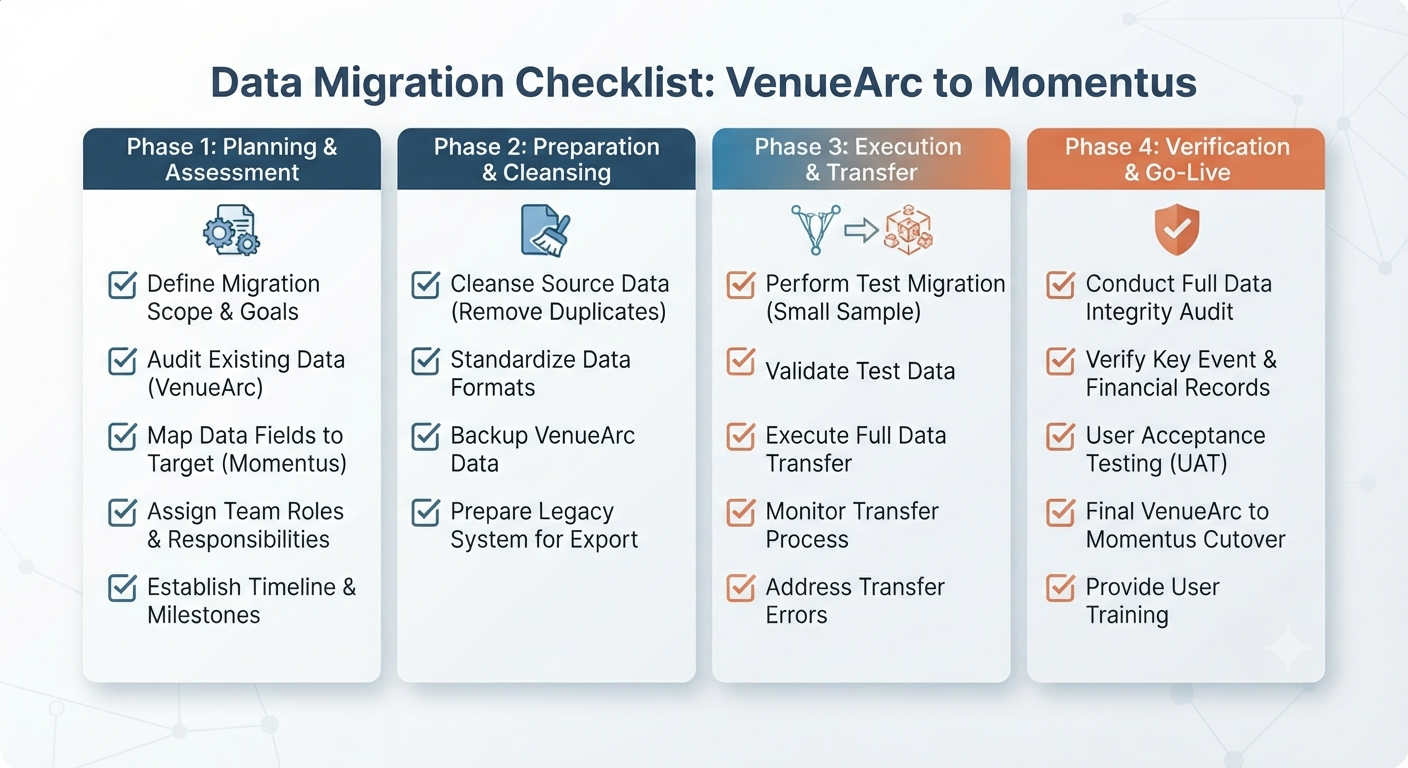
- Test migration feasibility — ask how the vendor handles moving your existing bookings, contracts, and client data
Demo Questions Worth Asking Any Vendor
- How long does implementation typically take for a venue our size?
- What does pricing include, and what counts as an add-on?
- How does the platform handle a double-booking conflict in real time?
- Can you show us a full inquiry-to-settlement workflow, not just booking?
- What does data migration from our current system actually look like?
- What reporting is available out of the box versus custom-built?
- What’s included in support and onboarding after go-live?
Migration Considerations
If you’re moving away from Momentus or another existing system, plan for:
- Booking and contact data — active and historical bookings, client records, and contact history
- Contracts and documents — existing templates and signed agreements that may need to be referenced going forward
- Calendar and scheduling data — current and upcoming holds and confirmed bookings
- Reporting history — settlement and utilization data your team may want for year-over-year comparisons
- Integration mapping — confirming your accounting, ticketing, and calendar integrations are supported in the new platform before cutover
A phased migration — moving active bookings first, verifying them, then running systems in parallel briefly — reduces the risk of losing an in-progress booking during the switch.
Common Challenges and How to Avoid Them
- Choosing based on brand recognition alone — a well-known platform isn’t automatically the right fit for your venue’s scale and workflow
- Underestimating implementation effort — enterprise platforms often require more onboarding time than smaller venues anticipate
- Comparing venue operations tools to registration tools — these solve different problems, and blending them in a single comparison leads to confusion
- Skipping the pricing conversation until late — quote-based pricing models mean real cost only becomes clear after a sales conversation, so start that conversation early
- Not testing the full lifecycle in a demo — booking is easy to demo; settlement and reporting depth are where real differences show up
Best Practices
- Match platform complexity to venue complexity — don’t pay for enterprise scope you won’t use
- Get a full-lifecycle demo, not just a booking calendar walkthrough
- Ask every vendor the same evaluation questions so comparisons are apples-to-apples
- Verify integration compatibility with your existing accounting, ticketing, and calendar tools before signing
- Plan migration in phases, prioritizing active bookings over historical data
- Revisit vendor fit periodically as your venue’s scale and needs change
Future Trends in Venue Management
- Right-sized platforms gaining ground — more mid-size and community venues are choosing purpose-built platforms over adapting enterprise suites designed for far larger operations
- Azure and Microsoft-native integration — increasing demand from venues already standardized on Microsoft 365 for platforms that integrate natively rather than through custom connectors
- Clearer separation between venue operations and registration tools — buyers are getting better at identifying which category actually solves their problem
- Faster implementation expectations — venues are increasingly prioritizing time-to-value over feature breadth alone
- Settlement and financial reporting depth — growing buyer expectation that reporting connects directly to booking and contract data, not a separate system
Bringing It All Together
Momentus and VenueArc aren’t really competing for the same buyer in every case — they’re built for different points on the venue-complexity spectrum. Momentus makes sense for large, enterprise-scale venues with the budget and internal resources to support a comprehensive, quote-based platform. VenueArc makes sense for venues that want a practical, connected booking-to-settlement workflow without that level of implementation weight.
The right move isn’t picking the more famous name or the longest feature list — it’s matching the platform to how your venue actually operates. If you’re managing a performing arts center, community theatre, house of worship, or mid-size multi-location operation, that fit is worth evaluating directly rather than assuming bigger is better.
For more on what to look for in venue booking software generally, see our venue booking software buyer’s guide before comparing specific vendors.
Curious whether VenueArc fits your venue better than Momentus? Request a demo to compare it directly against your current setup.
Frequently asked questions
- What is the best Momentus alternative for venue management?
It depends on venue type and scale. For large, complex venues, Momentus itself may remain the right fit. For mid-size, community, and performing arts venues, VenueArc offers a lighter-weight booking-to-settlement workflow.
That is a genuine answer rather than a hedge. Enterprise venue suites exist because convention centres and large arenas have requirements — complex resource logistics, extensive integrations, dedicated administrators — that lighter tools do not attempt to meet.
The mismatch arises when a venue without those requirements adopts a system designed around them. The result is not simply expensive; it is an implementation that consumes months, a configuration nobody fully understands, and a large share of capability that never gets used — while the day-to-day booking work stays as difficult as before.
- Is VenueArc a Momentus alternative?
Yes. VenueArc is positioned as an alternative for venues that want centralized booking, contracts, CRM, settlement, and reporting without the implementation scope of a full enterprise venue suite.
The distinction is scope rather than capability in isolation. Venues evaluating enterprise platforms usually want the same core outcome: one place where an enquiry becomes a hold, a contract, a confirmed event, and a settled invoice, with reporting that leadership can rely on.
What differs is what it costs to get there. Enterprise implementations assume a project team, a long configuration phase, and ongoing administrative ownership. Venues without that capacity — which is most mid-size and community venues — need something they can configure and run with the staff they already have.
- Is Momentus the same as Ungerboeck?
Yes. Momentus Technologies was formerly known as Ungerboeck.
The rename is worth knowing about during research, because a great deal of the material available online still refers to Ungerboeck. Reviews, comparison articles, case studies, and forum discussions written before the change describe the same product under the older name.
That matters practically when you are trying to assess a vendor. Searching only for the current name discards years of user experience, and searching only for the old one misses recent developments. If you are evaluating seriously, look under both — and treat older material with appropriate caution, since a product can change considerably over the period covered by that history.
- Is Momentus overkill for smaller venues?
For many smaller and mid-size venues, yes — the implementation effort and pricing structure are typically built around enterprise-scale operations.
“Overkill” is often misread as meaning the product is too powerful, which is not really the issue. Extra capability sitting unused is harmless. The cost is in what the capability demands: a longer implementation, more configuration decisions, and more ongoing administration.
That burden falls hardest on venues without dedicated systems staff. When configuration and troubleshooting land on someone who already runs the building full time, the practical outcome is that the system is never fully set up — and the venue continues working around it with the spreadsheets it intended to retire.
- How much does Momentus cost?
Momentus uses quote-based pricing rather than published flat rates. Cost depends on scope, usage, number of events, onboarding, and add-ons. Buyers should confirm current pricing directly with Momentus.
Quote-based pricing is normal in this category and not in itself a warning sign, but it does change how you should evaluate. Without published rates, you cannot compare until you have engaged a sales process, which makes it harder to rule options in or out early.
The practical advice is to ask for total first-year cost rather than a licence figure. Implementation, data migration, training, and add-on modules frequently exceed the subscription in year one, and a comparison built on licence cost alone can be misleading by a wide margin.
- What is the difference between venue management software and event registration software?
Venue management software handles booking, scheduling, contracts, and settlement for the space itself. Event registration software handles attendee sign-up, ticketing, and check-in for events already scheduled.
They serve different parties. Venue management serves the venue — protecting the calendar, the agreement, and the revenue. Registration serves whoever is running the event, whether that is your own team or a hirer.
Venues renting space to others often need only the first, since the hirer manages their own attendees. Venues producing their own programming usually need both, and the sequence matters: the space should be confirmed before registration opens, because unwinding a scheduling error after attendees have registered is a far larger problem than moving an unconfirmed date.
- Does VenueArc run on Microsoft Azure?
Yes. VenueArc is hosted on Microsoft Azure, with Azure Active Directory SSO and Azure SQL Database support.
This matters most during procurement and IT review. Organizations already standardised on Microsoft can evaluate the platform against infrastructure their teams already understand, rather than assessing an unfamiliar hosting arrangement from scratch.
Single sign-on has a practical benefit beyond convenience. When accounts are governed by your existing directory, access follows employment: a staff member who leaves loses access as part of the normal offboarding process rather than depending on someone remembering to remove a separate login. For venues handling contracts and client data, that is a meaningful reduction in a common and easily overlooked risk.
- What should I ask in a Momentus alternative demo?
Ask about:
- Implementation timelines — and what determines them
- Full pricing, not just features
- Real-time conflict handling, including tentative holds
- The complete inquiry-to-settlement workflow, end to end
- Migration support — what is included and what is not
The end-to-end workflow question is the most revealing, and the hardest to fake. Ask to see one enquiry travel the whole way — hold, quote, contract, deposit, confirmed event, settlement — rather than a tour of individual screens.
Demos naturally showcase strong features in isolation. Following a single booking through every stage exposes where the handoffs are awkward, which is where the daily friction will actually be.
Want technology done right?
Get a free assessment from an Inc. 5000 Microsoft Solutions Partner.
Get Free Assessment ->